3D Rendering with AI: Simulating Realistic Construction Sites to Prevent Workplace Accidents
Every year, thousands of construction workers around the world suffer injuries that could have been prevented. Traditional safety training relies on manuals, slide decks, and at best, generic video footage. But what if you could virtually recreate the exact construction site where work will take place, position the actual machinery in a realistic scenario, and simulate hazardous situations before they happen?
Today, thanks to the combination of 3D modeling and generative artificial intelligence, this is no longer science fiction. It is a concrete, accessible, and remarkably fast technology. In this article, we will show you step by step how a simple 3D model of construction machinery is transformed by AI into a photorealistic scene perfect for risk analysis and accident prevention.
The Starting Point: Basic 3D Models
Raw Machinery Geometry
Everything begins with 3D modeling of the machinery that will be deployed on site. In this first phase, a dump truck and a CAT motor grader are placed inside a neutral 3D environment, completely devoid of any environmental context.
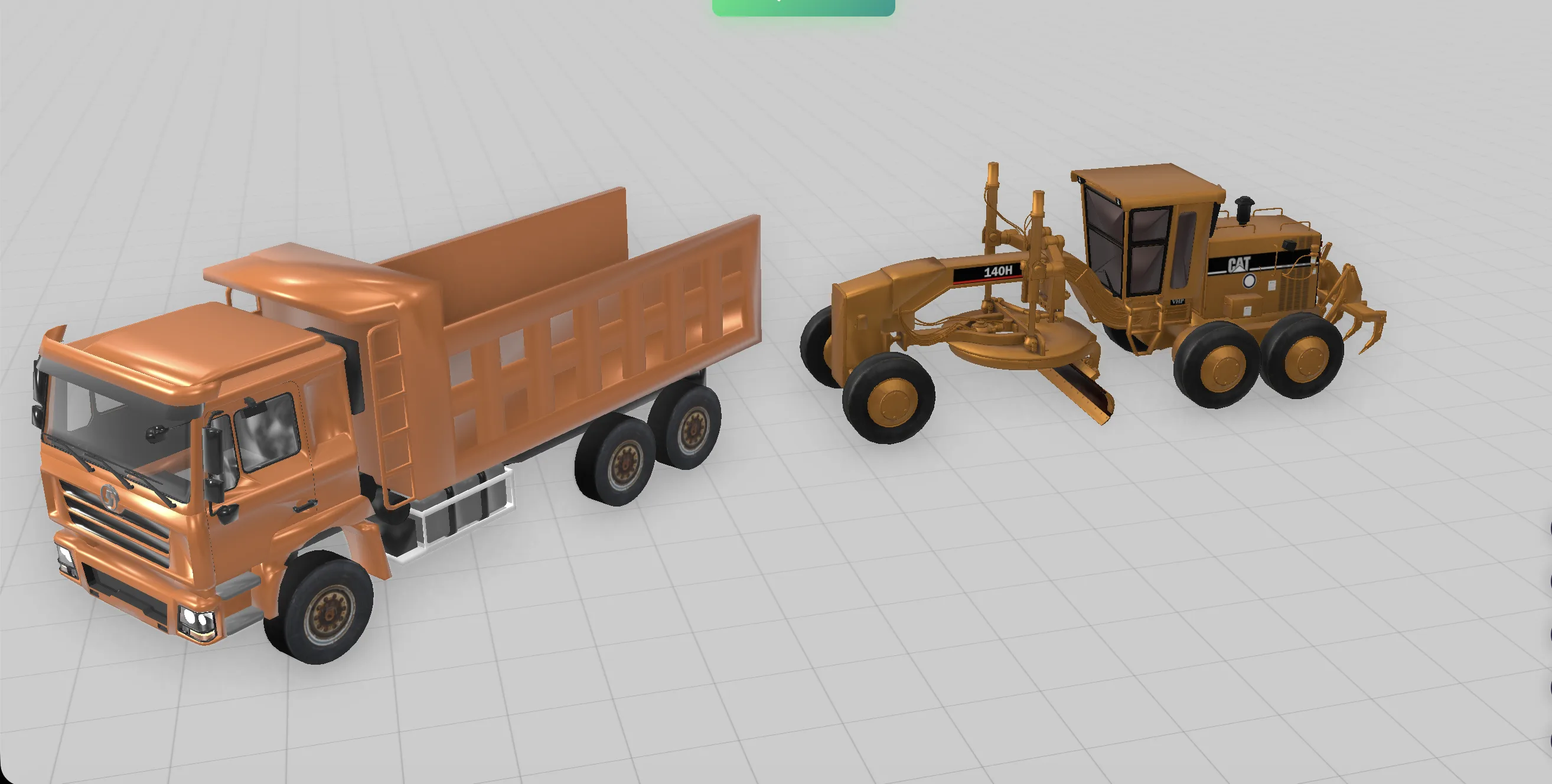
Look at the scene: we are looking at pure polygonal geometry. The machinery is recognizable by shape, but completely lacks realism. There are no shadows, no terrain, no sky. Yet, this is the fundamental foundation upon which artificial intelligence will build its work.
In a traditional workflow, from this point forward a 3D artist would spend hours, if not days, adding PBR (Physically Based Rendering) materials, setting up a global illumination system, placing the scene in an environmental context, and launching a render that could take minutes or hours for a single frame. With AI, this entire process is compressed into seconds.
Applying Textures and Base Lighting
From Geometry to Realistic Surfaces
In the second pass, the 3D models are enriched with realistic textures and dynamic shadows. The dump truck acquires its characteristic orange paint with wear marks, and the CAT motor grader displays brand details and the matte metallic surfaces typical of heavy machinery.
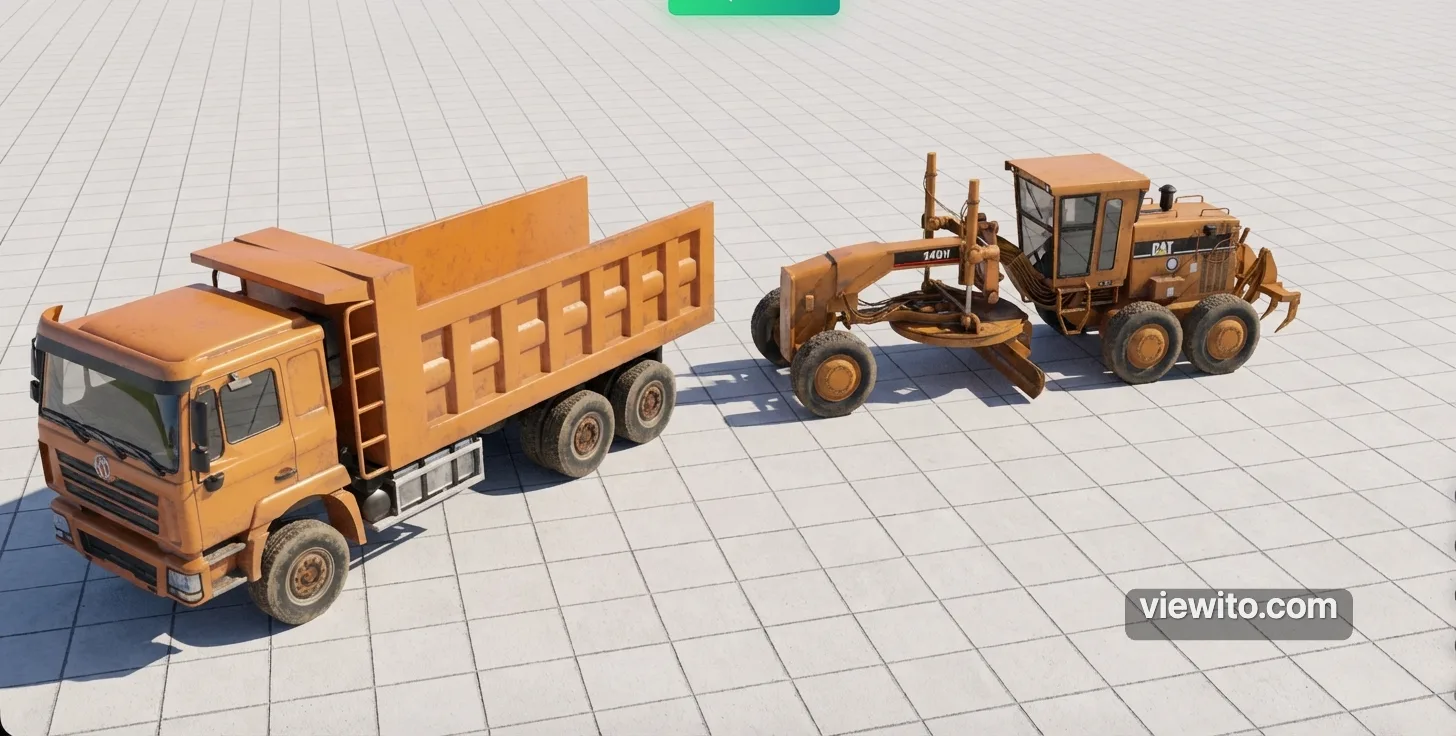
Notice the difference from the previous phase: shadows are now cast onto the ground plane with a consistent light direction, metallic materials reflect differently from painted surfaces, and mechanical details (tires, hydraulic joints, operator cabin) are now clearly distinguishable.
However, for a construction site safety analysis, this scene is still unusable. It lacks the operational context: the terrain where the vehicles will operate, surrounding structures, other workers, visibility conditions. And this is where artificial intelligence makes its decisive leap.
AI Reconstructs the Construction Environment
Immersion in Real-World Context
When the textured and shaded scene is fed into Viewito's AI rendering engine, something extraordinary happens. The artificial intelligence doesn't simply add a background: it reconstructs an entire coherent operational environment.
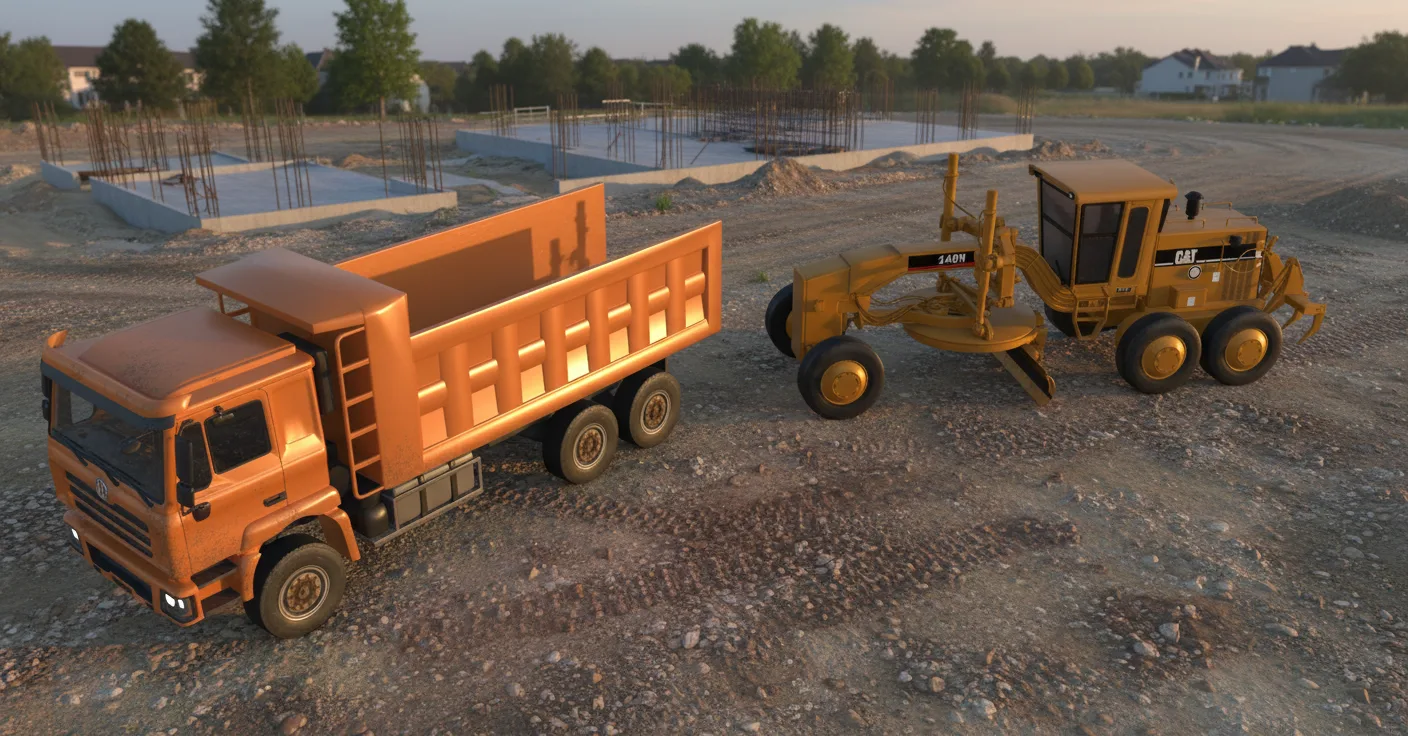
Examine the details of this transformation:
- Terrain and ground: The AI has generated irregular dirt terrain with tire tracks and ruts typical of an active construction site. The consistency of the mud and gravel is visually convincing.
- Structures under construction: In the background, foundations with exposed rebar, formwork, and concrete pours appear — exactly the type of structures you would find on a real construction site.
- Natural lighting: The light is that of late afternoon, with warm tones casting long shadows. This is a crucial detail for safety: reduced visibility at dusk is one of the leading causes of construction site accidents.
- Vegetation and context: Trees and houses in the background place the site in a suburban context, making the simulation even more specific and useful for logistics planning.
Identifiable risk scenario: In this scene, two heavy machines operate in close proximity to open foundations. A safety trainer could use this image to illustrate the risk of vehicle rollover on unstable terrain near unprotected excavations.
The Complete Construction Site: Total Photorealism
A Scene Indistinguishable from Reality
The fourth and final phase shows the full potential of generative AI applied to construction site simulation. Starting from the exact same 3D models, the artificial intelligence has generated a completely different variant: a large urban construction site in full operation.
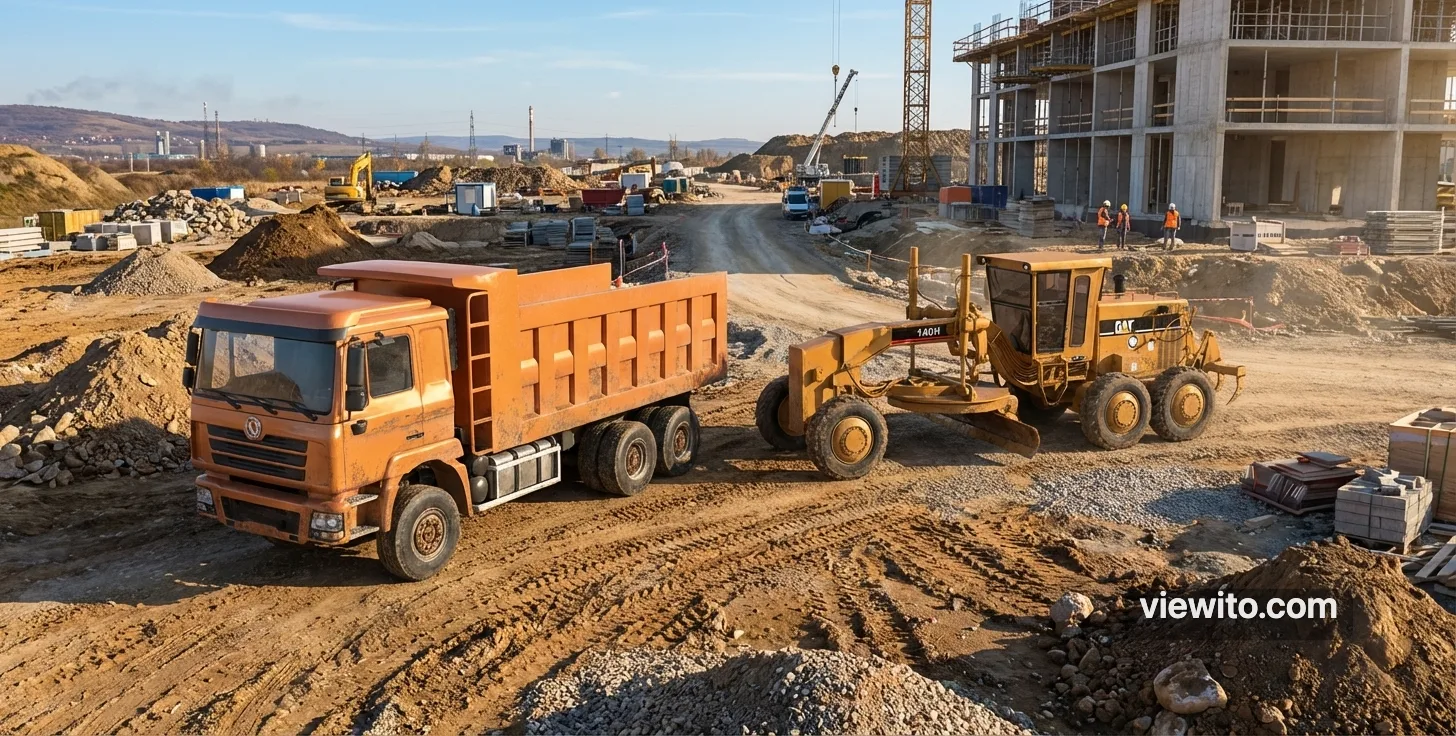
This scene is extraordinarily rich in details useful for safety analysis:
- Tower crane in the background: The AI has positioned an operational crane, recognizing that on a construction site of this scale, lifting equipment is inevitable. This opens training scenarios for crane swing radius hazards and loading/unloading zones.
- Multi-story buildings at different stages: Structures at various stages of completion are visible, with scaffolding and exposed reinforcement. Perfect for simulating falls from height, the most lethal risk in construction.
- Workers and other machinery: The presence of personnel and other moving vehicles enables simulation of struck-by incidents, equipment interference, and communication failures.
- Ground conditions: The muddy terrain and puddles indicate recent adverse weather, ideal for training on slipping, reduced traction, and vehicle stability.
- Scattered materials: In the foreground, debris and unstacked construction materials are visible — a classic trip-and-fall scenario that safety officers must be trained to identify.
The Complete Comparison: From Model to Virtual Reality
Let's place the starting point and the final result side by side to fully grasp the power of this technology:
From simple polygons on a gray grid to a photorealistic urban construction site with dozens of contextual elements. This transformation, which would traditionally require a team of 3D artists and days of work, is completed by AI in minutes.
Real-World Applications in Workplace Safety
AI-generated scenes are not merely decorative images. They are operational tools with concrete, immediate applications:
Immersive Personnel Training
Safety managers can use these visualizations to train workers on the specific site where they will be operating, not on a generic one. Every worker can visualize their station, safe pedestrian routes, vehicle maneuvering zones, and emergency assembly points.
Preventive Risk Assessment (Visual Safety Plans)
Risk assessment documentation can be enriched with photorealistic visualizations showing exactly the hazardous situations identified. Instead of describing in words that "the truck maneuvers near the excavation," you can show the exact scene, making risk communication immediately understandable.
Construction Site Logistics Planning
Before work even begins, the site layout can be simulated and optimized: positioning of site offices, heavy vehicle routes, material storage areas, access and exit points. All visualized photorealistically and shareable with all stakeholders.
Communication with Clients and Authorities
Public administrations, clients, and regulatory bodies can receive visual presentations of how the construction site will be managed from a safety perspective, improving transparency and collaboration.
According to OSHA, over 60% of fatal construction accidents are attributable to hazards that could have been identified and mitigated during the planning phase. 3D visualization with AI makes this planning more effective, accessible, and understandable for everyone.
Why AI Changes the Rules of the Game
Compared to traditional 3D visualization methods for safety purposes, AI-powered rendering offers decisive advantages:
- Speed: From days of work to minutes. You can generate dozens of variants of the same construction site in record time.
- Reduced cost: No specialized 3D artists or expensive render farms required. Just a base model and AI does the rest.
- Versatility: From the same base scene, you can generate daytime, nighttime, rainy, and foggy variants — all critical conditions for safety assessment.
- Iterability: If the site layout changes, the new visualization is ready in minutes, not days.
- Accessibility: No advanced technical expertise required. Anyone can upload a 3D model and obtain a professional rendering.
Transform Your 3D Models into Realistic Simulations
Use Viewito's artificial intelligence to generate photorealistic visualizations of your construction sites, work environments, and risk scenarios. From prevention to training, the future of safety is visual.
Try Viewito Free